

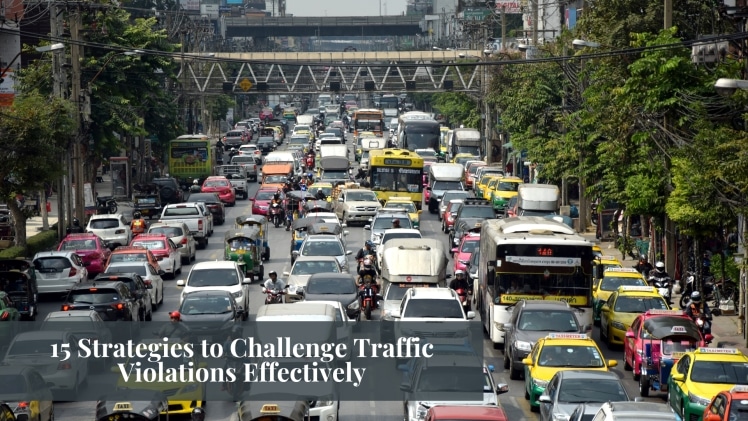
Receiving traffic violations is frustrating and costly, often leading to fines, increased insurance premiums, and points on your driving record. You have the right to contest a ticket if you believe it was issued unfairly. Disputing a traffic violation successfully entails a strategic approach, some solid evidence, and sometimes a bit of legal know-how.
In this article, we shall explore 15 effective strategies on how to challenge traffic violations and thus increase one’s possibilities of receiving a favorable outcome.
1. Understand the Specific Violation
First, understand the violation with which you have been charged to challenge a traffic ticket. Traffic laws are state-specific and even city-specific. First, read the exact code you were cited under and understand what the elements of the offense are. This will give you an idea if there was any mistake in issuing the ticket or whether there could be a plausible defense.
2. Retain the services of a Traffic Attorney
If your case is complex or involves serious consequences like a license suspension, it’s worth hiring a traffic attorney to represent you. To reduce your charge or potentially have the ticket dismissed, consider hiring a traffic ticket lawyers who can offer you legal experience to explain the subtleties in the traffic laws.
Consulting with experienced traffic ticket lawyers can significantly improve your chances of success, as they understand the nuances of traffic law and can identify possible defenses, such as procedural errors or inconsistencies in the officer’s report.

3. Document Everything Possible as Soon as Possible
Often, the strength of your case is in the evidence you can show. Immediately after being given a ticket, acquire as much evidence as possible that supports your claim of false accusation. This evidence could include photos or videos of traffic signs, road conditions, or even weather conditions at the time of the incident. Ask for any witnesses’ contact information and if they’d be willing to provide a statement.
4. Put Notes on What Happened
As soon as possible after the stop, write down everything that happened. Include details like location, time, traffic conditions, your speed, the officer’s behavior, and anything else that may be pertinent. These notes will be gold when you have to recall details at a later time in court or while discussing with a lawyer about your case.
5. Search the Ticket for Technical Errors
Take out your traffic ticket and study it for technical mistakes. Mistakes in the date, time, location, or even spelling of your name might get it dismissed. Of course, minor errors do not always get a ticket thrown out, but serious mistakes can render the ticket invalid.
6. Research Applicable Traffic Laws
Arm yourself with knowledge by researching the traffic laws related to your violation. Understanding precisely what the law requires and defines will help you build a good defense.
For example, if you were cited for running a stop sign, you might research what constitutes a complete stop according to the local laws and see whether there was an exception or a mitigating factor in your case.
7. Consider Pleading Not Guilty
Here, you tell the court that you’d like to fight your ticket. You will subsequently have the opportunity to testify and introduce evidence to a judge. In general, this is how someone goes about fighting a traffic ticket, and usually is done within the date on your ticket.
8. Request a Trial by Written Declaration
In some jurisdictions, you have the right to contest your traffic ticket, through what is commonly referred to as a trial by written declaration. In essence, it’s where you can present your evidence and arguments in writing and never come before a judge.
The officer who gave you the ticket will also submit his statement in writing, and then a judge determines which is more compelling. You can make use of this when you do not like the idea of appearing before the court, but you have to be ready with a written defense or argument.
9. Challenge the Officer’s Observation
Many traffic offenses are judged on the subjective view of the issuing officer. You can contest the officer’s view in court if you feel they are incorrect. For example, you might demonstrate that the view of the issuing officer was obstructed, that the lighting was poor, or that the officer misjudged your speed or position.
10. Challenge the Accuracy of the Equipment Used
Whether you were cited for a strict liability violation of the speeding or red light variety, there may be some room to argue the inaccurate readings of equipment that issued your ticket. For instance, radar guns must be calibrated and serviced regularly.
You may be able, then, to cast doubt on the reading of your speed if you can prove that the radar gun in question was not properly calibrated.
11. Ambiguous Signage
All traffic signs and traffic signals must indicate what a driver should or should not do. If you received a ticket for a traffic sign or signal violation, such as failure to stop at a stop sign or exceeding the speed limit on any given road, then the ambiguity of the signage, that it was not visible or even present is a valid argument.
12. Necessity Defense
Sometimes, depending on your circumstances, you can argue that your act was necessary to avoid greater harm. This is called a necessity defense. If you swerved into the lane of another car to avoid hitting a pedestrian or another vehicle, it could be argued that your actions were necessary to avoid an accident.
13. You Were Not Driving
This is if you got a ticket in the mail, such as from a red light camera. In this instance, you could contest that it wasn’t you driving. You could provide an alibi for the time of the offense or show another person was driving your car.
14. Cross-examine the Officer
You also have the right to cross-examine the officer who issued your ticket, if your case goes to trial. This may be your opportunity to point out discrepancies in the officer’s testimony or bring into question the reliability of his or her observations. For that matter, a good cross-examination has sometimes been enough to bring the prosecution’s case down to reasonable doubt.
15. Show It Was an Honest Mistake
The courts sometimes are forgiving if you can prove that the infraction was an honest mistake and you have taken steps to never allow it again. An example may be if you were cited for running a red light; you might argue that you misinterpreted the signs but since then have reviewed the traffic codes and are committed to driving safely.
Conclusion
Contesting a traffic ticket can be quite difficult unless its strategies are known and prepared. Learn the specific offense, collect evidence, research the laws applicable to your case, and seek the assistance of a lawyer if possible.
Using these strategies, you might even get a traffic ticket dismissed, have the penalties reduced, or just get a fair hearing resulting in the best outcome possible for the situation.
FAQs
1. Can I fight a traffic ticket without going to court?
Yes, in some jurisdictions, you are entitled to appeal the traffic ticket via a trial by written declaration.
2. What happens if I lose my challenge to the traffic infraction?
In case you lose, you will be liable for the fine and additional penalties but can appeal the decision.
3. Is it worth hiring a lawyer to fight a traffic ticket?
It may also be advisable to hire an attorney, especially in cases involving complicated issues or severe sentences in most instances, to successfully appeal the case.
