

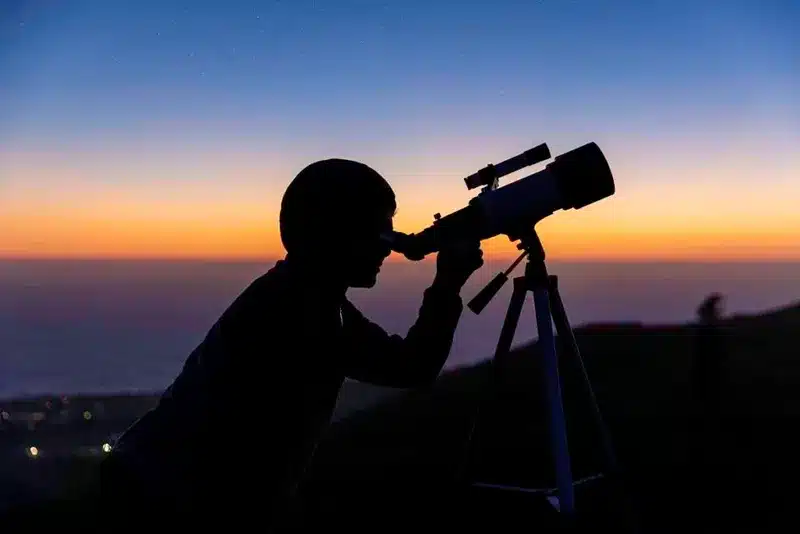
Stargazing is a magical hobby that opens up the wonders of the universe right from your backyard. Choosing the right telescope can make all the difference in your experience, especially if you’re just starting out. Let’s go through the basics of selecting your first telescope, ensuring you make an informed decision that will enhance your stargazing adventures.
Understanding the Basics of Telescopes
What is a Telescope?
A high quality telescope is a tool that allows you to see distant objects in the sky with greater clarity. By gathering and focusing light, telescopes reveal details of the moon, planets, stars, and deep-sky objects that are invisible to the naked eye. Whether you’re looking to explore craters on the moon or marvel at distant galaxies, a telescope is your gateway to the cosmos.
Types of Telescopes
Refractor Telescopes: These use lenses to gather light. They are easy to maintain and provide sharp images, making them ideal for viewing the moon and planets. However, they can be more expensive per inch of aperture compared to other types.
Reflector Telescopes: These use mirrors instead of lenses. They are generally more affordable and offer larger apertures for their price, making them great for deep-sky observations. However, they require regular maintenance like mirror cleaning and alignment.
Compound Telescopes: Also known as catadioptric telescopes, these combine lenses and mirrors to offer the best of both worlds. They are versatile and portable, suitable for various types of observations, but they can be pricier.
Key Factors to Consider When Choosing a Telescope
Aperture
The aperture is the diameter of the telescope’s main lens or mirror, and it’s the most crucial feature. A larger aperture gathers more light, allowing you to see fainter objects and finer details. For beginners, a telescope with an aperture of at least 70mm for a refractor or 114mm for a reflector is recommended.
Focal Length and Focal Ratio
The focal length is the distance over which the telescope’s optics focus light. The focal ratio (f/number) is the focal length divided by the aperture. A lower f/number (fast scope) gives a wider field of view, ideal for deep-sky objects, while a higher f/number (slow scope) is better for lunar and planetary details.
Mount Types
Altazimuth Mount: Simple and intuitive, this mount moves up-down and left-right. It’s great for beginners but not ideal for astrophotography.
Equatorial Mount: Designed to follow the rotation of the Earth, making it easier to track celestial objects. It’s a bit more complex but excellent for long-exposure astrophotography.
Dobsonian Mount: A type of altazimuth mount that supports large reflectors. It’s user-friendly and stable, perfect for beginners who want a big aperture on a budget.
Choosing the Best Telescope for You
Are you unsure of what the best telescope will be for your needs? Whether you’re new to the hobby of exploring or you’ve been gazing for many years, the equipment you choose is going to be imperative to your experience. You don’t want to rush into the decision and regret it later on.
So, in order to find the best telescope, you have to sit down and consider what you need. Here are a few elements you should debate so that you can find the best telescope for your budget, needs and goals.
Your Goals
First, think about what you want to achieve with a telescope. Some people are just looking for a new hobby and wish to do some casual stargazing. Others are more committed and are carrying out studies. Having an idea of what your goals are will pinpoint you in the right direction of what you need to purchase in terms of equipment.
Your Experience
Ask yourself about your experience. Are you used to working with telescopes, or is this something completely new to you? It can dictate what model is going to be best for you. For instance, beginners won’t take advantage of some of the advanced features of a telescope, so they can be better off with a basic and easy-to-use one.
Where You Will Use
You also want to think about where you’re going to be using your telescope. Some people are happy to use them at home, which means they can choose larger and heavier models. But if you’re planning on bringing your telescope with you when you’re travelling, you must consider portable and lightweight versions that will make your life easier.
Know Your Budget
Don’t forget to think about what you’re willing to pay for a telescope. The price varies greatly, from affordable beginner models to expensive equipment that costs thousands. Of course, you don’t want to be in a situation where your finances suffer. So, you must think about what your budget is and what you would like to spend on a telescope. Think about a price range and this can help you narrow down your options.
Conclusion
Choosing your first telescope is an exciting step into the world of astronomy. By understanding the basics, setting a realistic budget, and considering your needs, you’ll be well-equipped to start your stargazing journey.
